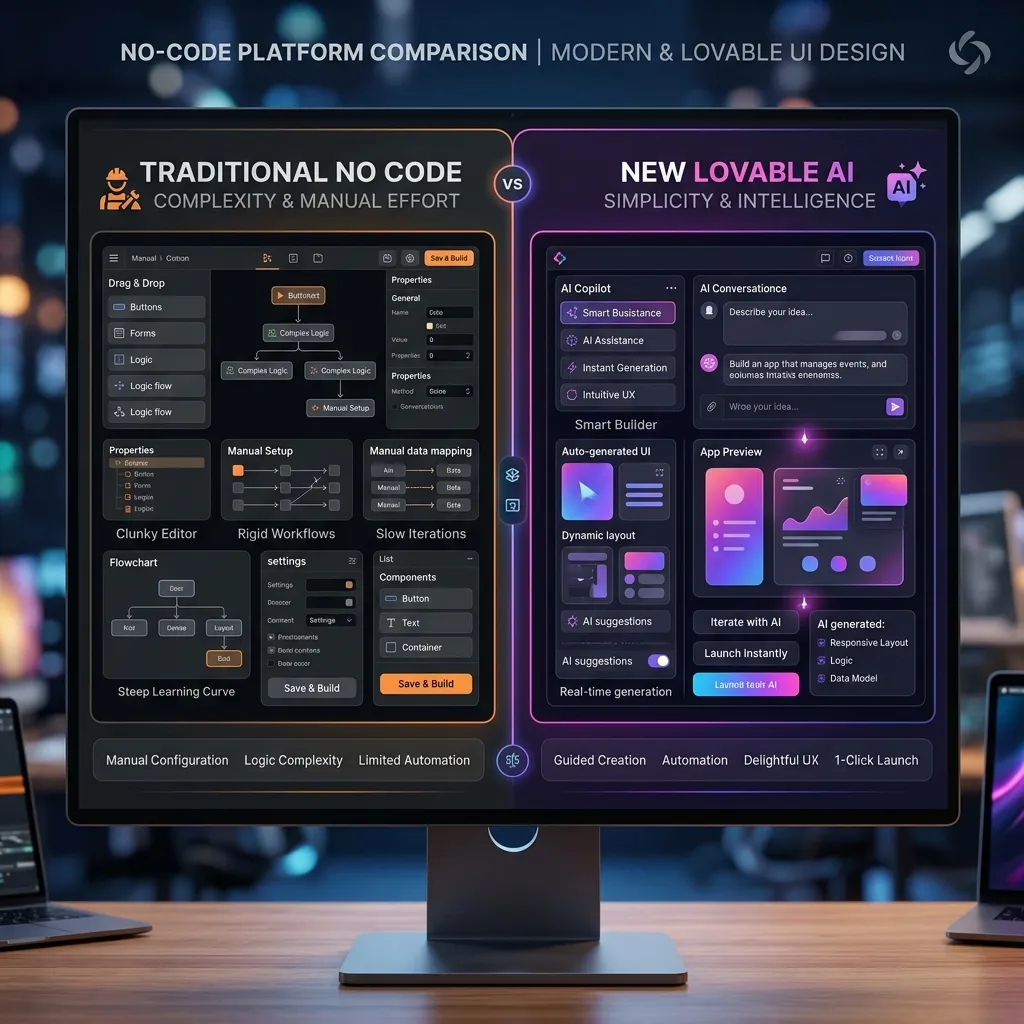
The no-code software movement has undergone an incredible evolution over the past decade. For several years, Bubble.io was the undisputed king of visual web development. Its highly customizable visual database builders and powerful event-driven workflows empowered millions of entrepreneurs to build complex SaaS applications without typing a single line of syntax.
However, by 2026, the tech landscape has shifted completely. The rise of advanced large language models has given birth to a brand-new software category: AI-Generated Code (pioneered by platforms like Lovable.dev). In this comprehensive comparison, we will analyze the trade-offs, architecture, design systems, and hosting models of Bubble and Lovable to help you choose the best engine for your startup MVP.
The Foundational Shift: Visual Blocks vs. Natural Language
At their core, the two platforms represent entirely opposing software development philosophies:
- Bubble.io: Operates as a visual IDE. You start with a spatial canvas, drag-and-drop structural elements (inputs, texts, buttons), map data collections visually, and link logic via visual event chains. While highly powerful, it demands months of active study to master.
- Lovable AI: Operates as a conversational code orchestrator. You do not drag blocks. You write detailed English prompts (e.g., "Build an automated client booking portal integrated with Stripe and Supabase"). The AI compiles the schema, structures the backend, and outputs standard React code. This matches the paradigm shift discussed in death-of-traditional-no-code-generative-ai.
 Building First Visual MVP on Lovable.dev
1. Shipping Speed & Ease of Onboarding
If your absolute priority is validation speed, Lovable AI wins by a massive margin. By bypassing spatial layout calculations, a beginner can prompt and ship a beautiful, fully functional full-stack app in under an hour.
With Bubble, building even a basic login-gated user dashboard requires configuring container parameters, building responsive margins, and setting up workflows manually, which takes days of careful execution.
2. Architectural Scaling & Computational Limits
When analyzing complex business logic and databases:
- Bubble: Houses a highly robust visual database manager. It handles complex relational linkages and background workflows natively within its visual console.
- Lovable AI: Is exceptional for prototyping core features. While extremely massive codebases can occasionally push AI context limits, Lovable has a secret weapon: it outputs pure code. You can export the directory and use cursor-ai-vibe-coding-2026 to refactor, scale, and host your project without any platform limits.
 The Death of Traditional No-Code Platforms
3. The "Vendor Lock-in" and Code Ownership Analysis
This represents the single most critical decision parameter for early-stage startup founders:
- Bubble Enforces Strict Lock-in: Your application lives permanently on Bubble's closed-source hosting platform. You cannot export your source code to host it on AWS or Vercel. If Bubble changes its pricing tiers or shuts down, your startup is completely vulnerable.
- Lovable AI Grants 100% Code Ownership: Lovable generates industry-standard Next.js, React, and Tailwind CSS files. You can export the entire repository to GitHub at any second. You own every line of code and can host it anywhere you like.
4. Visual Aesthetics & Responsive Layout Engines
- Lovable AI: Generates incredibly sleek, premium visual layouts out-of-the-box using the industry-standard shadcn/ui framework. Achieving a modern cyberpunk or minimalist glassmorphic design is effortless.
- Bubble: The default templates look outdated. Making a Bubble app look highly premium and modern requires an exceptional eye for design and deep knowledge of CSS responsive layout settings. You can enhance your design workflow using the ultimate-workflow-v0-cursor blueprint.
5. Hosting Overhead & Cost Structures
- Bubble: A live commercial application requires upgrading to their paid tiers, ranging from $29 to $119+ per month. Furthermore, as your database reads and visual workflows scale, you can trigger unexpected "Workload Unit" fees that quickly become expensive.
- Lovable AI: Their $20 to $35/month plan is primarily for development. Because you can export the raw code, you can host your production app on Vercel or Netlify's free tiers, bringing your recurring hosting cost down to practically zero.
The Showdown: Detailed Comparison Matrix
| Feature / Metric | Lovable.dev | Bubble.io | | :--- | :--- | :--- | | Development Paradigm | Prompt-driven AI Code Generation | Visual drag-and-drop no-code | | Code Exportability | 100% Exportable (Git/Zip) | Closed Source (Complete Lock-in) | | Onboarding Curve | Ultra-Low (Natural English) | Medium-High (Requires study) | | Application Speed | Highly optimized, light React | Heavier, slower page-load times | | Database Control | Open (Supabase/PostgreSQL) | Closed (Proprietary visual schema) |
Conclusion: The Startup Decision Framework
Choose Lovable AI if:
- You want to launch a modern, high-performance SaaS MVP in a single weekend.
- You refuse to be locked into a proprietary platform and want full ownership of your product's source code.
- You want beautiful, accessible shadcn/ui layouts out-of-the-box.
Choose Bubble if:
- You are comfortable spending months mastering a visual programming language.
- Your app requires incredibly complex relational database pipelines and heavy backend trigger automation.
[!TIP] Did you know that all developer tools on CodePreviewer.com operate 100% client-side inside your browser sandbox? None of your source code, Stripe credentials, or private database keys ever leave your browser tab, ensuring ultimate safety for your IP.
Frequently Asked Questions (FAQs)
Q1: Is it possible to migrate an existing Bubble application to Lovable?
There is no direct automated importer due to their completely different software engines. However, you can easily take screenshots of your Bubble UI and paste them into Lovable, instructing the AI to recreate the exact layout and database schemas from scratch in minutes.
Q2: Can a non-technical founder manage the code exported from Lovable?
Yes! Since the exported directory uses standard Next.js and Tailwind, the founder can easily make modifications by loading the folder into cursor-vs-vs-code-2026 and using Cursor's AI Composer to execute updates in plain English.
Q3: How secure are databases connected to Lovable?
Lovable utilizes Supabase (PostgreSQL) which provides enterprise-grade data security. By ensuring that Supabase Row-Level Security (RLS) is enabled, your user records remain completely isolated and secure. Learn more in our debugging-for-non-coders-ai-code guide.
Q4: Does Lovable support custom integrations that lack official plugins?
Absolutely. Since Lovable generates standard React code, you can easily integrate any public web API, software library, or analytics tool simply by instructing the AI to implement the raw integration steps.
Q5: What role do client-side developer tools play in this transition?
When transitioning from visual builders to AI code generation, you'll frequently interact with raw JSON API responses and JWT tokens. Using 100% client-side developer tools (like those available at CodePreviewer.com) ensures you can format, inspect, and validate your data with zero privacy risks. Because the data is processed entirely in your browser sandbox, your proprietary logic and customer data are never exposed to external servers.
Q6: Will I save money by switching from Bubble to Lovable?
Generally, yes. While you pay for the AI subscription to generate the code, hosting a standard React/Next.js application on platforms like Vercel or Netlify is often free or very low cost compared to Bubble's tiered, usage-based pricing models. You maintain complete control over your infrastructure expenses.
Frequently Asked Questions
1. Are these AI tools safe to use for production code?
Yes, but you should always review the generated output. Tools like Cursor and Bolt.new provide excellent starting points and functional components, but human oversight ensures the final application is secure, performant, and aligned with your specific business logic.
2. Can I use CodePreviewer alongside these tools?
Absolutely! One of the best workflows for vibe coding is to take the UI components generated by tools like v0 or Bolt.new, and paste them directly into CodePreviewer's HTML Sandbox. This allows you to instantly test, tweak, and validate the code entirely client-side without spinning up a local development environment. Because CodePreviewer processes everything in your browser, your code remains 100% private.
3. Will traditional no-code platforms disappear?
They won't disappear overnight. Platforms like Bubble still offer robust backend integrations and visual database management. However, generative AI tools are bridging the gap rapidly, making it easier for non-coders to create complex, scalable applications without being locked into a proprietary visual editor.