
The global tech ecosystem sees dozens of new AI-powered tools launch every single week, but only a tiny handful truly deserve to be labeled as legitimate "game-changers." Lovable AI (Lovable.dev) is one of these rare, breakthrough platforms that has taken the software development community by complete storm.
If you are a startup founder, product strategist, or solo creator with a brilliant idea and a desire to launch a high-quality Minimum Viable Product (MVP) in record time, this comprehensive review is for you. We will dive deep into Lovable AI's core capabilities, structural features, performance trade-offs, and pricing models in 2026.
What is Lovable AI?
Lovable AI is a next-generation, conversational full-stack web application builder. Its primary mission is to compress the long, friction-heavy "Idea-to-Product" journey into a seamless, rapid flow.
Traditionally, launching a web app required a developer to configure frontend models, draft secure backend servers, map relational databases, and configure API routes. Lovable AI collapses all of these steps into a single conversational interface. You explain what features your app needs in plain, natural English, and the platform generates a fully working product. This approach directly matches the concepts in death-of-traditional-no-code-generative-ai, where traditional visual blocks are replaced by clean code output.
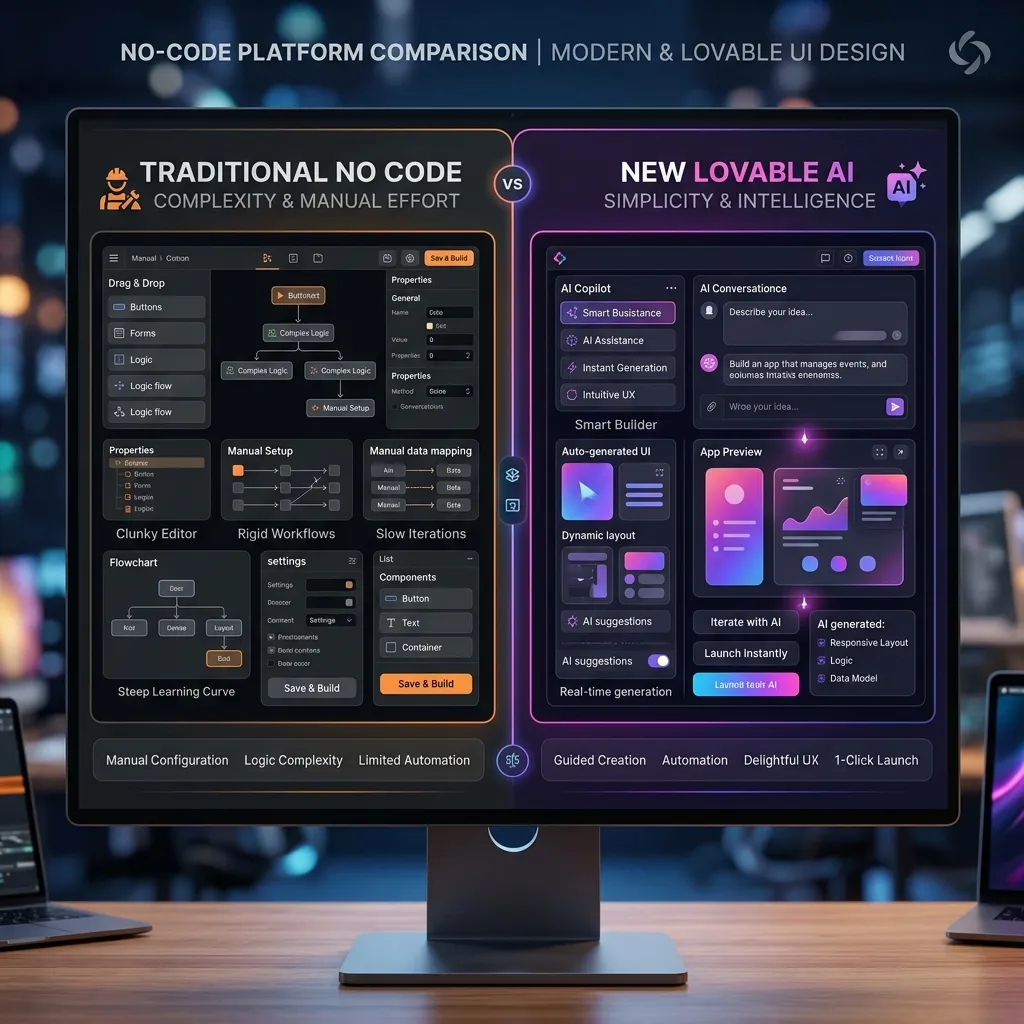 Lovable AI and Bubble Dashboard Comparison
Core Architectural Features
1. Lightning-Fast Prototyping & Scaffolding
The absolute biggest selling point of Lovable AI is its extreme execution speed. By prompting:
"Create a premium B2B dashboard for a cleaning service company. Include scheduling, client tracking, and dark-themed metrics."
The AI drafts a complete, beautiful multi-page directory structure with functional state handling in under a minute.
2. High-Performance, Exportable Codebase
Unlike older visual page builders that output bloated, unmaintainable markup, Lovable AI writes industry-standard React, TypeScript, and Tailwind CSS code. You are not locked into their ecosystem. You can export your codebase at any second and continue building locally inside cursor-ai-vibe-coding-2026.
3. Integrated Databases & Payments
Lovable does not stop at simple frontends. It features direct integrations with Supabase (PostgreSQL) and Stripe (subscriptions and payments). This allows non-technical creators to launch functional B2B SaaS applications that capture real customer transactions.
The User Experience (UX) & Prompt Interface
The user interface of Lovable is exceptionally intuitive. It divides your screen into two sections: the prompt editor on the left and a live-updating interactive browser sandbox on the right.
- Conversational Refinement: If you need to alter a visual layout or button color, simply chat: "Make all card elements glassmorphic and add glowing cyan accents."
- Self-Healing Compilation: If the underlying packages trigger runtime compiler conflicts, the platform's background debugger self-corrects the code immediately, utilizing the logic described in our debugging-for-non-coders-ai-code manual.
 The Generative AI No-Code Paradigm Shift
Deep Supabase & Stripe Integrations
Creating real database connections is typically the hardest part of software engineering. Lovable AI makes this painless:
- Database Scaffolding: Connect your Supabase API keys, and the AI automatically writes and runs the SQL migrations to structure your tables.
- User Authentication: Logins, password resets, and route protections are built-in automatically.
- Billing Workflows: You can connect Stripe customer accounts and manage subscriptions via chat commands.
To design the absolute best hybrid workflow with this tool, consult our ultimate-workflow-v0-cursor guide.
Lovable AI Pricing Models
Lovable AI structures its subscriptions competitively:
- Free Sandbox: Allows creators to test the generation engines and build basic client-side prototypes free of charge.
- Pro Subscriptions ($20 to $35 / month): Offers custom domain mappings, prioritize processing queues, secure database configurations, and full GitHub codebase exports. Compared to hiring a senior software developer, this is an incredible value.
The Verdict: Pros & Cons
Pros:
- The absolute fastest way to transition from an idea to a live production MVP.
- Outputs clean, standard, and highly exportable Next.js/Tailwind directories.
- Sleek, premium aesthetic styling out-of-the-box (utilizing shadcn/ui components).
- Zero vendor lock-in; you retain complete code ownership.
Cons:
- Complex enterprise applications with niche algorithms can occasionally push the AI to its context limits.
- Advanced developers seeking custom Docker configurations might find the hosting pipeline restrictive.
Conclusion: Should You Build with Lovable?
Without a doubt!
If you are a non-technical entrepreneur or product team looking to validate a startup idea without waiting months or spending thousands of dollars on software agencies, Lovable is your ultimate tool. It bridges the gap between vision and reality in a single weekend. Stop waiting and start shipping!
[!TIP] Did you know that all developer tools on CodePreviewer.com operate 100% client-side? None of your project files, environment keys, or Stripe/Supabase credentials ever leave your local browser tab, ensuring absolute data security.
Frequently Asked Questions (FAQs)
Q1: Can I host my Lovable AI app on my own servers?
Yes! Lovable allows you to connect your project directly to GitHub. You can export the codebase and deploy it to your own AWS, Vercel, or Netlify account at any time, completely bypassing vendor lock-in.
Q2: Do I need to understand coding to edit my app?
Not at all. You can request any modifications—including layout changes, database tables, or payment integrations—in plain natural English directly within the chat panel.
Q3: Are applications built on Lovable fully responsive?
Yes. Lovable utilizes Tailwind CSS and mobile-first design practices out-of-the-box, ensuring your product looks flawless across smartphones, tablets, laptops, and wide monitors.
Q4: How does Lovable compare to traditional no-code platforms like Bubble?
Unlike Bubble, which hosts your app on a proprietary closed-source server structure, Lovable generates standard React and TypeScript code that you fully own and can host anywhere, offering infinitely superior performance and scaling potential. Check out lovable-vs-bubble-no-code-2026 for more details.
Q5: How important is client-side testing when building MVPs?
When iterating on MVPs using tools like Lovable, you frequently need to format JSON payloads or debug JWT tokens. Using client-side developer tools (such as those at CodePreviewer.com) guarantees 100% privacy. Your Supabase keys, API credentials, and user data remain entirely within your browser, ensuring no sensitive information is leaked to third-party servers.
Q6: Can Lovable integrate with third-party APIs easily?
Absolutely! Lovable's AI is extremely adept at reading API documentation. If you need to integrate external services like Stripe for payments or SendGrid for emails, simply paste the relevant API documentation into the prompt, and it will handle the implementation securely.
Q7: What kind of applications are best suited for Lovable?
Lovable excels at building SaaS dashboards, internal company portals, marketplaces, and directory websites. If your application relies on data entry, user authentication, and clear UI components, Lovable can generate the MVP incredibly fast.
Frequently Asked Questions
1. Are these AI tools safe to use for production code?
Yes, but you should always review the generated output. Tools like Cursor and Bolt.new provide excellent starting points and functional components, but human oversight ensures the final application is secure, performant, and aligned with your specific business logic.
2. Can I use CodePreviewer alongside these tools?
Absolutely! One of the best workflows for vibe coding is to take the UI components generated by tools like v0 or Bolt.new, and paste them directly into CodePreviewer's HTML Sandbox. This allows you to instantly test, tweak, and validate the code entirely client-side without spinning up a local development environment. Because CodePreviewer processes everything in your browser, your code remains 100% private.
3. Will traditional no-code platforms disappear?
They won't disappear overnight. Platforms like Bubble still offer robust backend integrations and visual database management. However, generative AI tools are bridging the gap rapidly, making it easier for non-coders to create complex, scalable applications without being locked into a proprietary visual editor.