
Over the past decade, the No-Code Movement promised a massive, democratic revolution in software engineering. The core pitch was simple yet incredibly powerful: anyone, regardless of their technical background or math skills, could build full-scale web and mobile applications using visual, drag-and-drop interfaces. Platforms like Bubble, Webflow, and Adalo empowered millions of non-technical entrepreneurs, marketers, and product teams to bring their ideas to life without hiring expensive software agencies.
But in 2026, the software development landscape has shifted dramatically. The meteoric rise of Generative AI has initiated a brand-new era of software creation known as "AI Code Generation" or "Vibe Coding." Today, founders are moving away from traditional drag-and-drop visual editors and are simply telling AI what to build in plain English, generating clean, custom source code instantly.
This raises a massive, critical question for tech creators: Is traditional visual no-code officially dead? Let's dive deep into the limitations, comparative parameters, and structural shifts defining this next era.
The Structural Limits of Traditional No-Code
Traditional visual no-code tools initially served as phenomenal entry points for validating early assumptions. However, as applications scale in user volume and logical complexity, the cracks in visual-first platforms become impossible to ignore:
- The Vendor Lock-in Trap: If you architect your startup using Bubble.io, your product resides permanently on their closed-source servers. You cannot export the underlying source code to host it on AWS or Vercel. If the platform alters its subscription tiers or goes offline, you have no leverage.
- Sub-optimal Performance & Bloat: Visual builders generate heavy, unoptimized code layers to translate dragging motions into database actions, resulting in high latency, slower page loads, and poor mobile responsive metrics.
- Rigid Feature Customization: Visual no-code locks you into pre-configured layout boxes and plugins. The moment your business logic requires a custom integration or niche calculation not supported by their library, development stalls.
Explore these comparisons further in our lovable-vs-bubble-no-code-2026 comparison.
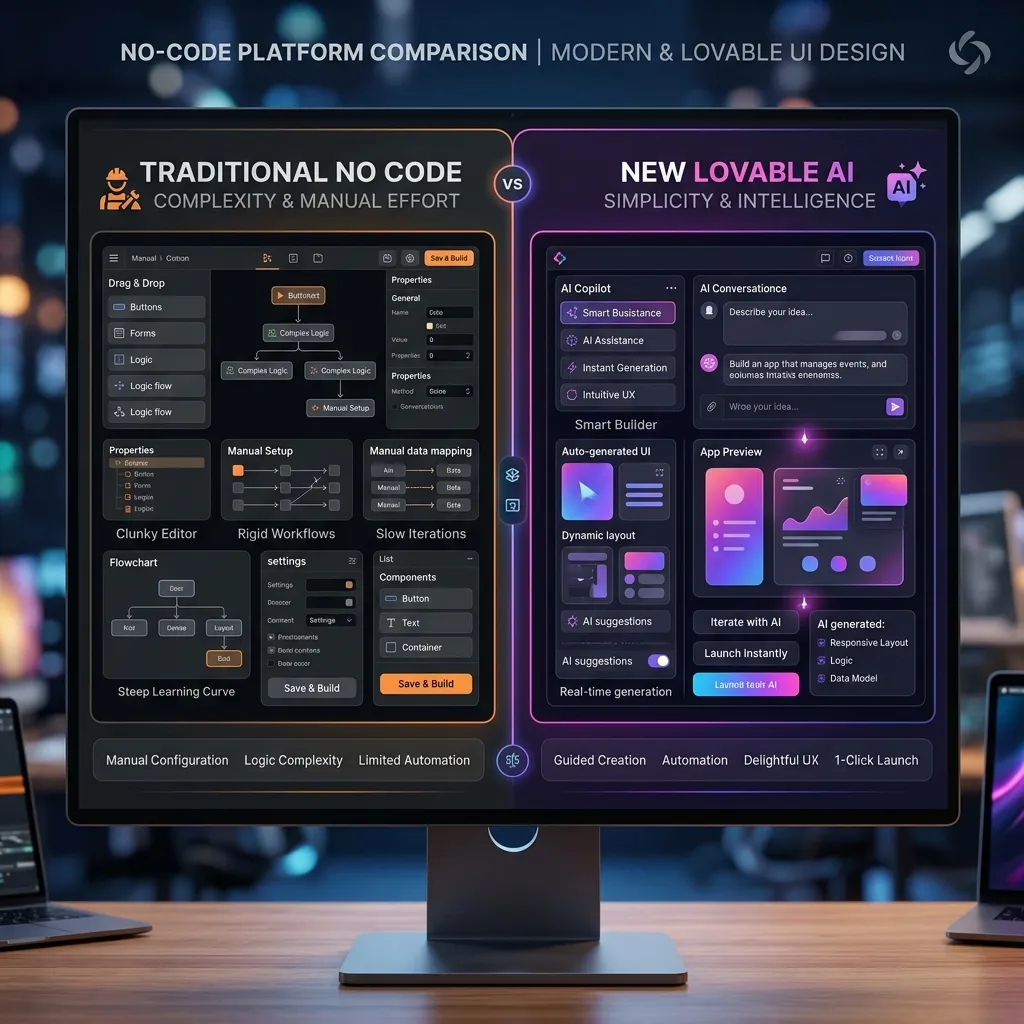 Lovable.dev vs Bubble.io No-code Interfaces
The Advent of AI Code Gen: Pure Democratization
In 2026, platforms like Lovable.dev, Bolt.new, and Cursor AI have fundamentally altered the software architecture playbook. Instead of spending hours aligning visual layout components on a spatial canvas, creators write precise, natural English declarations.
By prompting: "Create an automated subscription billing flow connected securely to Stripe and a Supabase database," the generative models draft industry-standard React or Next.js code instantly. This merges the ease of no-code with the absolute scalability of custom engineering.
AI-Generated Code vs. Traditional No-Code: Core Differences
1. Bypassing the Vendor Lock-in Trap
This is the ultimate game-changer for modern founders. When you build using AI code generators, you retain 100% absolute ownership of your product's source code.
- You can export the raw directory at any second.
- Commit the codebase securely to GitHub.
- Host the assets on cheap, high-performance static hosting platforms like Vercel, Netlify, or AWS.
- Bypassing visual platform subscription monopolies completely.
2. High-Performance Execution & Mobile Speed
Traditional no-code websites require browsers to load massive engine runtimes before displaying content. AI-generated code (typically structured using React, Vite, and Tailwind) is incredibly lightweight, compiling into highly optimized bundles that load in milliseconds on mobile devices. If you utilize v0-by-vercel-review for UI generation, your frontend metrics remain flawless out-of-the-box.
3. Infinite Adaptability & Instant Debugging
When a traditional no-code platform breaks or behaves unexpectedly, you must wait for their engineering team to deploy a patch. With AI-assisted code, if an error displays in the terminal, you simply implement debugging-for-non-coders-ai-code steps: paste the error to the LLM, and the AI repairs the syntax within seconds.
 Lovable AI Generative Visual Sandbox
The Learning Curve: Visual Pipelines vs. Natural Language
Many beginners discover that learning visual no-code tools (like Webflow or Bubble) is surprisingly difficult. Navigating their complex responsive database managers and custom trigger systems can take months of active study.
With Generative AI, the learning curve is tied entirely to your language clarity (Prompts). By mastering prompt-to-product-step-by-step-ai, you can design complex system features on day one.
The Software Engineering Blueprint of 2026
Traditional no-code will not disappear completely; it will remain highly useful for simple internal tools, basic contact forms, or visual-only marketing sites.
However, for commercial B2B SaaS, scalable web platforms, and mobile apps, AI Code Generation has established itself as the new global standard. Top-tier creators utilize a blended approach called the ultimate-workflow-v0-cursor to design, build, and scale rapidly.
Conclusion & Takeaways
If you are beginning a new web project or startup validation cycle today, do not spend valuable capital or time learning complex, closed-source no-code drag-and-drop systems. Switch directly to modern AI code generation tools to secure a highly scalable, open-source foundation for your business.
[!TIP] Did you know that all developer tools on CodePreviewer.com operate 100% client-side inside your browser sandbox? None of your custom code segments, environment keys, or proprietary ideas are uploaded to our servers, keeping your IP safe.
Frequently Asked Questions (FAQs)
Q1: Do I need to learn to program to start using AI code generation?
No! Generative coding focuses entirely on writing logical instructions (Vibe Coding) rather than memorizing syntactical structures. Having a basic understanding of folder organization and layout components is helpful, but the AI handles the heavy technical execution.
Q2: What are the best use cases for traditional visual no-code tools today?
Traditional no-code tools remain excellent for simple internal company wikis, basic portfolio displays, and low-scale forms where database relationships and code speed are not primary priorities.
Q3: How do AI-generated applications scale in production?
AI-generated apps compile into standard enterprise code (like TypeScript, React, and Python). They can be hosted on highly scalable cloud networks like AWS and scale to support millions of active users without any platform bottlenecks.
Q4: Is it easy to find developers to maintain an AI-generated codebase?
Yes! Since the output is standard industry code (like Next.js and Tailwind), any standard professional developer can easily read, modify, and extend your repository without needing platform-specific certifications.
Q5: How does this relate to client-side privacy?
When you write code with AI, you often need to test snippets or manipulate data structures. Traditional servers process your data externally, but using modern client-side developer tools (like those found on CodePreviewer.com) ensures 100% privacy. Your code, API keys, and sensitive data never leave your browser sandbox, eliminating the risk of data leaks while iterating on AI-generated applications. This paradigm perfectly complements the open-source ownership you gain from AI coding.
Q6: Can I export my code anytime?
Unlike traditional no-code platforms that lock you into their ecosystem, AI code generation gives you raw files. You maintain absolute ownership of your intellectual property and can host it anywhere, ensuring long-term flexibility.
Frequently Asked Questions
1. Are these AI tools safe to use for production code?
Yes, but you should always review the generated output. Tools like Cursor and Bolt.new provide excellent starting points and functional components, but human oversight ensures the final application is secure, performant, and aligned with your specific business logic.
2. Can I use CodePreviewer alongside these tools?
Absolutely! One of the best workflows for vibe coding is to take the UI components generated by tools like v0 or Bolt.new, and paste them directly into CodePreviewer's HTML Sandbox. This allows you to instantly test, tweak, and validate the code entirely client-side without spinning up a local development environment. Because CodePreviewer processes everything in your browser, your code remains 100% private.
3. Will traditional no-code platforms disappear?
They won't disappear overnight. Platforms like Bubble still offer robust backend integrations and visual database management. However, generative AI tools are bridging the gap rapidly, making it easier for non-coders to create complex, scalable applications without being locked into a proprietary visual editor.